The Shift Change Nightmare
A call center isn’t like a regular office. The same row of workstations runs three shifts — morning, afternoon, and overnight. One locker cabinet, six people sharing it throughout the day. First shift clocks out and empties their stuff. Second shift fills it back up. Third shift does it again at 3 a.m.
Three hand-offs a day. Lock cylinders getting turned over and over — dozens of cycles every twenty-four hours. Cheap painted steel lockers can’t take that frequency. Three months in, the lock cylinder goes loose. A few more weeks and the key won’t even turn. Eventually people stop locking them at all. Why bother if the lock is broken?
A BPO campus logs over a dozen phone and wallet theft complaints every year. All because the lockers couldn’t stay locked. These aren’t major crimes — they’re just the kind of thing that poisons an office atmosphere. Nobody should have to worry about their stuff while they’re on a call.
We’ve been making stainless steel lockers for nine years. BPO facilities are one of our main lines. All-steel lock cylinders — dozes of cycles a day, no loosening, one key lasts three years. Security isn’t a label. It’s whether the lock holds up.
The Lock — Let’s Be Honest
When a BPO campus buys lockers, the lock is the last thing on the checklist. They look at appearance, price, dimensions. Then the order lands and the first thing that fails is the lock.
The problem with cheap steel lockers isn’t that the lock can’t stop a thief. It’s that the lock can’t survive the job. Three turns a day. Ninety a month. Over a thousand a year. The springs inside a standard lock cylinder fatigue. The key stops going in. Force it, and the key snaps off inside the cylinder. That locker door is done — either break it open or leave it unused.
Our lock cylinders are all steel — the springs, the pins, the housing. No zinc alloy shortcuts. Across a batch of 200 lockers, the key clash rate is negligible — you’re not going to unlock someone else’s door by accident. One key works for three years without a maintenance call.
Shift Work — The Locker Doesn’t Belong to Anyone
In a normal company, one employee gets one locker. They keep it for years. In a BPO, the logic is different. The locker belongs to the workstation, not the person. Today the morning shift uses it. Tomorrow the afternoon shift. Day after, the overnight shift.
That means double the wear. The same locker door opened and shut by different people three or four times a day. Hinges and handles fatigue faster. Cheap lockers use zinc alloy hinges — a few months and the door starts sagging. The latch no longer lines up with the strike plate.
Our hinges are 304 stainless steel. The door frame is pressed from a single sheet — no welded joints that can loosen over time. High-frequency shift use doesn’t faze it.
Air Conditioning Kills Steel Lockers
BPO offices run air conditioning 24/7. In a tropical climate, outside it’s over 30°C with humidity pushing 90%. Inside, the AC brings it down to 22°C. The outer surface of a steel locker goes through condensation cycles every single day — moisture in the warm air hits the cold metal and condenses into beads of water. By the end of a shift, you can see water running down the cabinet.
Condensation seeps under the paint on a steel locker. Rust starts at the edges and works its way in. Six months later, the row of lockers nearest the AC vent is the first to rot.
Stainless steel doesn’t rely on a paint layer for rust protection — it is rust protection. Condensation sits on the surface all day. Wipe it dry, done. No paint blistering. No edge rust. The lockers near the AC vent look the same as the ones in the middle of the office three years later.
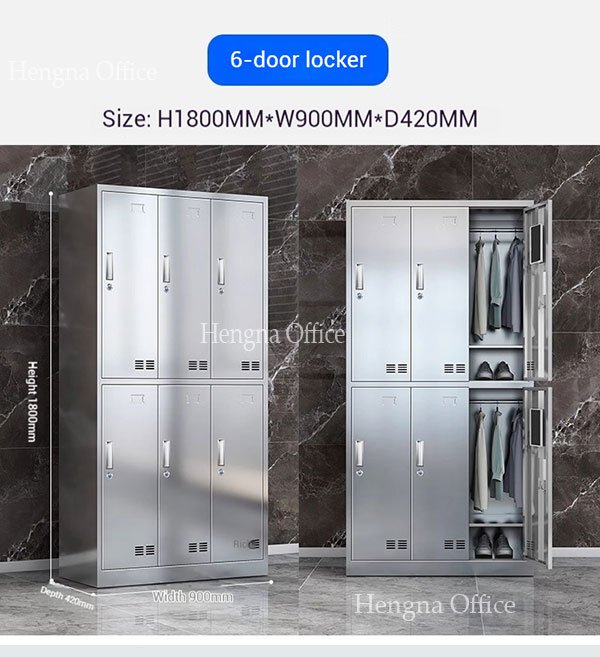
6-Door Stainless Steel Staff Locker — Spec Sheet
| Item | Specification |
|---|---|
| Overall Height | 1800 mm |
| Overall Width | 900 mm |
| Overall Depth | 420 mm |
| Layout | 2 rows × 3 columns, 6 compartments |
| Compartment Height | Approx. 580 mm |
| Compartment Width | Approx. 430 mm |
| Compartment Depth | 420 mm |
| Body Material | 201 Stainless Steel |
| Surface Finish | Brushed, matte |
| Door | Single swing, recessed pull handle |
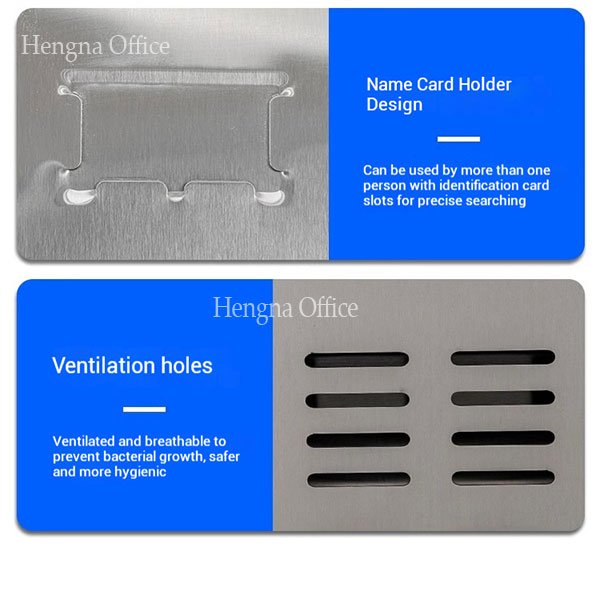
| Ventilation | Dual-row long vents per door |
| Lock | Full steel cylinder, 2 keys, very low key clash rate |
| Identification | Transparent label holder on each door for staff ID cards |
| Interior | 1 coat rod + 1 shelf |
| Approx. Weight | 35–40 kg |
| Delivery | Fully assembled — unpack and use |
Three People Sharing — How the Interior Works
Each compartment in the 6-door cabinet has a coat rod and one shelf. Here’s how shift workers use it:
- Coat rod for jacket and uniform (the AC is strong, everyone needs a layer)
- Shelf for personal items — charger, earphones, snacks
- Below the shelf for a bag
If staff need to store a laptop, we can add a locking storage box at the bottom of the compartment. Lock your laptop in with your own code at the end of the shift. This is common in BPO centers across Europe and the US, and a growing number of clients in Asia are adding it as well.
How It Ships
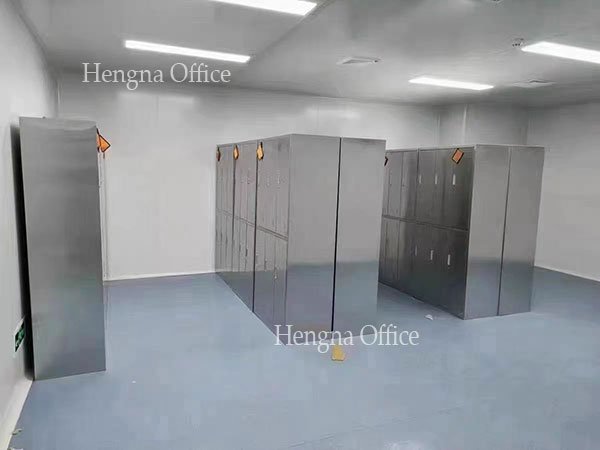
Fully assembled, three-layer packaging. Arrives at port, load a truck, haul it straight to the BPO campus. Unwrap, push into place next to the workstation. Done. No on-site assembly, no waiting for a fit-out crew.
FAQ
Q: How many keys per locker? Two as standard. HR keeps a spare. The shift worker uses the other one. Hand over the key at shift change — that’s it.
Q: Can you fit electronic locks? Yes. PIN code or card-access, integrated with building security if needed. That said, most BPO clients still go with mechanical locks. Electronic locks cost more and take longer to repair when they fail. Mechanical locks are simple, tough, and quick to fix.
Q: What happens when someone loses a key? They go to HR for the spare and get a copy made. BPOs have high staff turnover — lost keys are normal. That’s exactly why we ship two keys as standard. We’re not worried you’ll lose one. We’re counting on it.
Q: What’s the warranty? 201 stainless in a normal office environment lasts over 10 years. Painted steel lockers — 2 to 3 years before doors loosen and locks jam. You decide: replace locks every year, or not think about it for a decade.
Bottom Line
A locker in a BPO isn’t furniture — it’s the tool shift workers hand over three times a day. It needs to lock. It needs to hold up. It needs to survive the humidity.
201 stainless steel. All-steel lock cylinder. Arrives fully assembled. Price depends on port and quantity. Contact us for an FOB or CIF quote — reply within 24 hours.