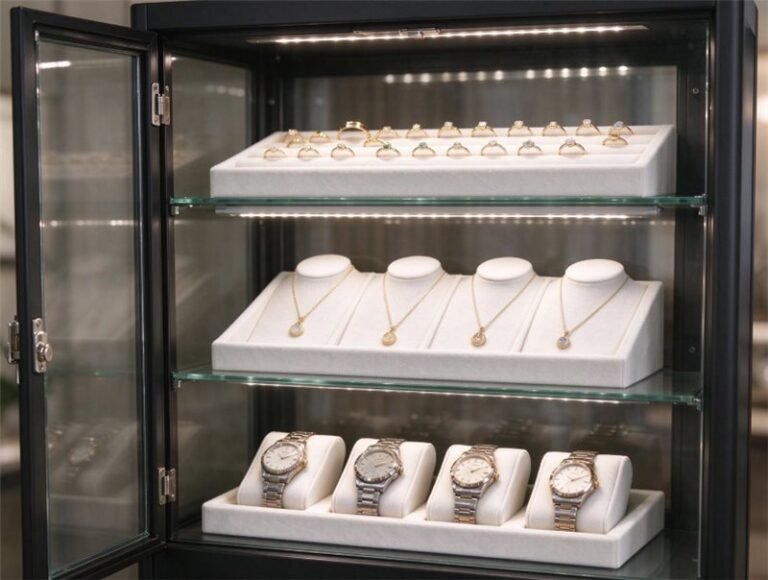
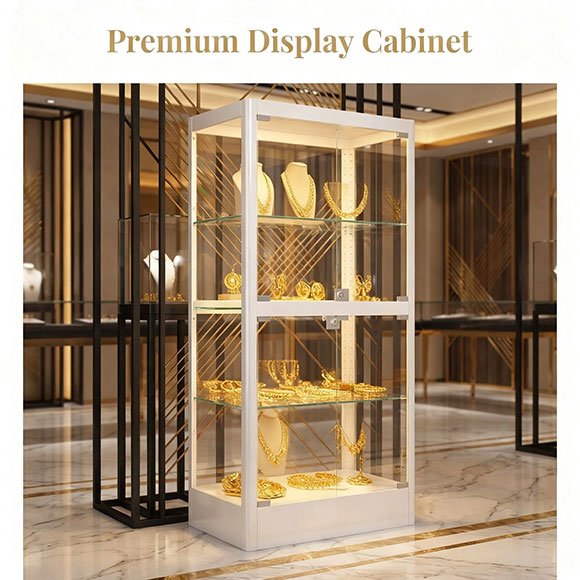
Jewelry retail runs on a contradiction: the products on display are small enough to pocket and valuable enough to matter, yet they sell precisely because customers can see them up close. Every display decision in a jewelry store is a negotiation between exposure and protection — and the cabinet you choose is where that negotiation lands. A lockable jewelry display cabinet is not an accessory to the shop design; it is the piece of equipment the whole security plan rests on.
This guide is written for jewelry retailers, counters inside larger stores, and shopfitters building out jewelry sections — anyone specifying lockable glass display cabinets at wholesale. It covers what the lock actually needs to do, which glass specification holds up in a jewelry environment, where the cases work hardest, and what to confirm with a factory before ordering. Prices are deliberately left out: they depend on your specification, and a factory that quotes blind is guessing — the factors behind every quote are the same seven, and they are worth understanding before you compare numbers.
Why lockable cases are non-negotiable in jewelry retail
Most retail display is about presentation first and security second. Jewelry inverts that order. The stock on a jewelry counter has the highest value-per-gram of almost anything a store displays, and it is displayed at hand height, within reach of every customer who leans in. An unlocked case does not just invite theft — it invites handling: customers pick pieces up, pass them around, set them down on hard surfaces. Scratched bands and chipped settings are losses too, just slower ones.
A lockable case changes the interaction script. Customers look through glass, point at what interests them, and a member of staff opens the case. That small friction does three jobs at once: it deters grab-and-go theft, it stops accidental damage from handling, and it turns every viewing into a conversation with a salesperson — which is where jewelry actually gets sold.
What to look for in a lockable jewelry display cabinet
The lock mechanism comes first
“With lock” on a quotation can describe anything from a cheap cam lock to a precision mechanism — and in jewelry retail the difference is the product. The specification worth asking for is a precision mechanical lock with a dual key system: two different keys are required to open the case, so no single lost or copied key opens your stock. Staff hold one key, management the other. Ask what the lock is made of and how the key is cut — a lock that is specified in writing is a lock that was chosen, not assumed.
Glass clarity and strength
Jewelry sells through detail: the fire in a stone, the finish on a band, the engraving on a clasp. Glass that distorts or tints kills the sale before it starts. Tempered glass with high transparency — 98% and above — shows the piece as it is, and it is five times stronger than standard glass: if it breaks, it breaks into blunt granules instead of shards, on a floor full of customers. Tempered glass also filters more UV than open shelving or acrylic, which slows the fading of display packaging and velvet inserts. For flagships and high-security installations, laminated glass is the step up — it holds together even when cracked.
Lighting that sells
Jewelry is the one category where the display case is expected to glow. Factory-fit LED strips per shelf turn every tier into a lit stage — and because the wiring channels get cut during production, the decision belongs at order confirmation. Retrofitted lighting rarely looks clean. Ask how the strips are powered and whether the channels are finished or exposed.
Layout for trays, depth for service
Jewelry is displayed flat, in trays — rings in rows, pendants on pads, watches on cushions. That display style needs shallower, tighter shelf spacing than general retail, plus enough depth under the glass for tray lids to open if the design allows viewing from above. Adjustable shelving lets the case switch between ring walls, pendant bars, and watch cushions as your stock mix changes across seasons.
Where jewelry retailers use them
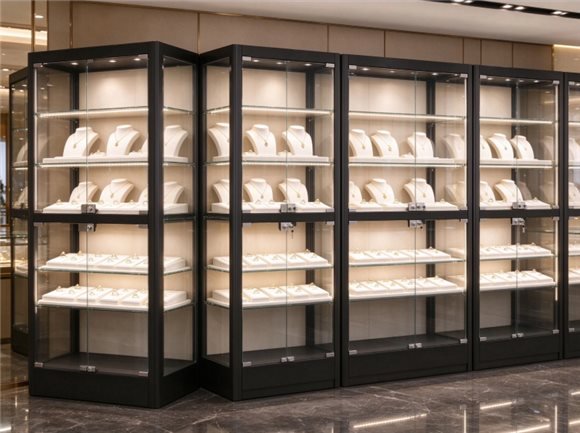
Showroom floor lines. Rows of lockable cases form the backbone of a jewelry floor — consistent height, consistent lighting, consistent lock system across the line. The matte black or moonlight white frames stay neutral under spotlights, so the metal colors of the pieces keep their own story. A uniform case specification across the line also makes the security plan easier to document — one lock type, one key system, one set of procedures for staff.
Back counters and private viewing. High-value pieces move to locked cases behind the counter, where viewings happen seated and staff-controlled. A case with a dual key system fits that workflow: the floor team holds one key, the manager the other. It also keeps the glass cleaner — handling happens over the counter, not inside the case, so the display stays presentation-ready between cleanings.
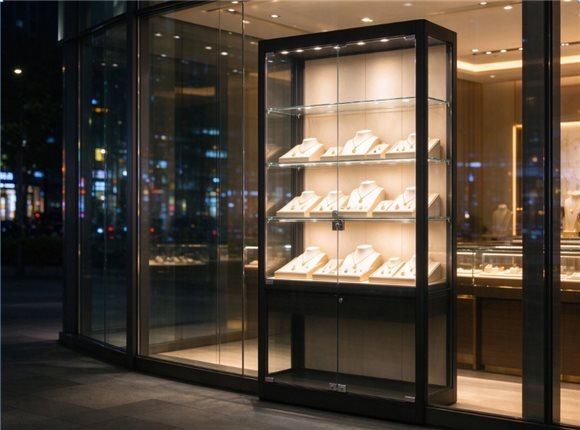
Window and facade displays. A lockable glass tower in the window brings stock to the street — visible from the pavement, locked against everyone outside it. Because the case ships knock-down, it can also move with a refit instead of being rebuilt on site. And an LED-lit tower keeps working after dark — a lit window display is the only advertising space a jewelry store truly owns.
Ordering from the factory
Specifications are flexible at the factory level: dimensions, glass thickness and grade, lock type, finish color, and LED layout are all configurable across the line — OEM and ODM both supported. Cases ship knock-down: frames flat-packed, glass crated separately with corner protection, which cuts freight per unit substantially and reduces damage in transit. Every order goes out with QC photos of the batch before the container seals, and export documentation — commercial invoice, packing list, certificate of origin, CE file — travels with it. Current minimums, volume pricing, and payment terms are confirmed in writing with the quotation, because they differ by model and order size.
Common questions
Will jewelry fade or tarnish inside a glass case? The glass slows UV compared with open shelving, but it does not block it completely. Pieces with sensitive stones or treated surfaces should sit away from direct sunlight, and stores in hot climates should ask about UV-filtering glass options at specification stage.
Can the finish match my store’s interior? Standard production colors include vintage black, moonlight white, and cream white. Custom RAL and Pantone matches run from one container up — enough to align frames with your joinery, signage, or brand palette.
How are the cabinets shipped? Knock-down flat packing with foam interlayers; glass crated separately with corner protection. The design survives long-lane freight — and because the case assembles with basic tools, it can be installed without specialist crews.
Can one case hold rings, pendants, and watches together? Yes — adjustable shelving and tray-style layouts mix categories per tier. Most stores dedicate tiers by category and keep one tier for the highest-value pieces under the strongest lighting.
What certification comes with the glass? The tempered glass ships with its certification paperwork in the export file. For specific market requirements — ANSI, EN, or local standards — raise them at specification stage so the right glass is in the build.
Get a quote
Send quantities and target specs to Ms. Ivy Zhang — ivy.zhang@atoolcabinet.com or WhatsApp +86 135 2691 8367. Luoyang Hengna Office Furniture Co., Ltd., 9 years of industry experience, CE certified production line, direct supply to trade buyers worldwide. For a full jewelry section fit-out, include your floor plan dimensions and we will come back with layout suggestions along with pricing.
Related reading: for the finish that pairs with white display cases, the moonlight white showcase guide covers the five-tier collectible-store layout. For the wider boutique range, the commercial showcase wholesale guide covers the full line. And if material choice is still open, the sideboard material guide compares steel against wood and MDF.