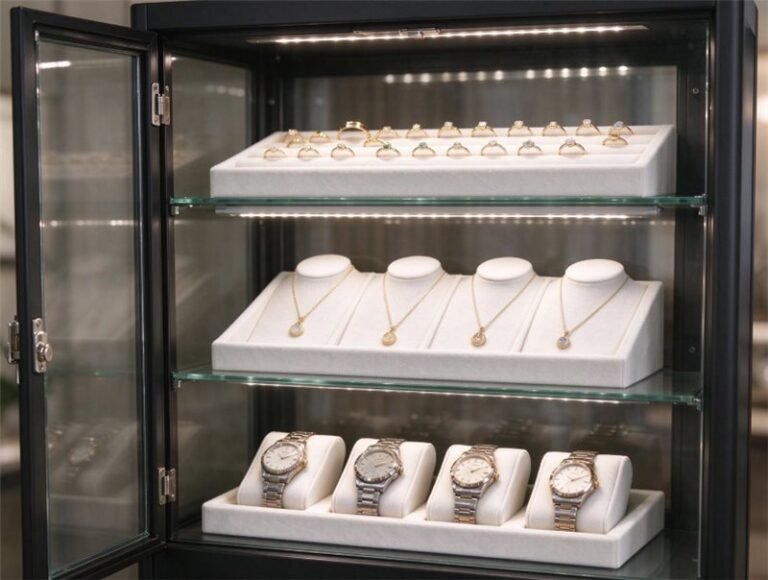
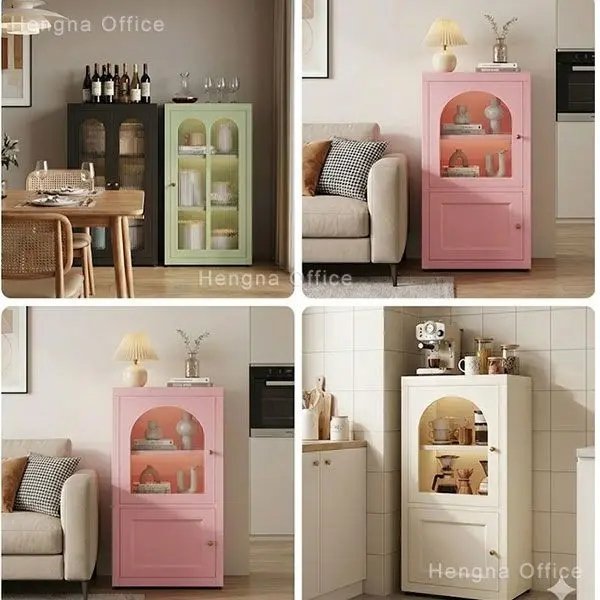
Ask three factories for a commercial glass display cabinet quote and you will get three different numbers — sometimes for what looks like the same cabinet. Most buyers assume someone is padding the price. Occasionally that is true. More often, the three quotes are simply not for the same thing: different glass, different steel, different packing, different everything. The gap stops being a mystery once you know what sits behind each line item.
So, how much does a commercial glass display cabinet cost from China? The honest answer: it depends on seven factors, and this guide walks through each one — glass grade, size, lighting, locks, finish, packing, and order volume. There is no single number here, because a factory that quotes blind is guessing. What you get instead is the ability to read any quote and know exactly what moved the price — and what to push back on.
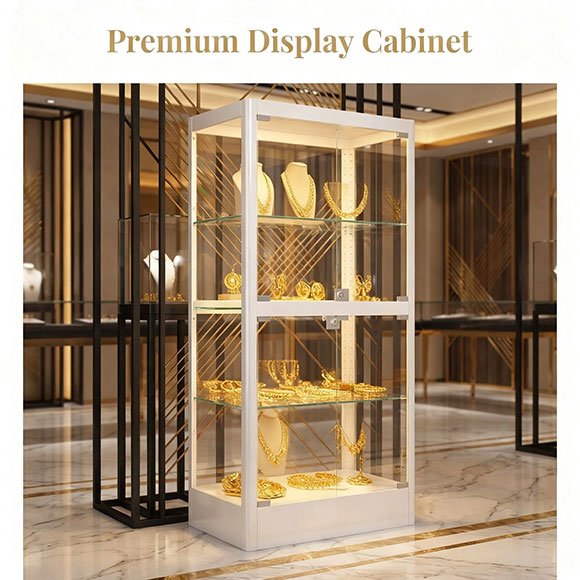
The 7 factors behind every quote
1. Glass thickness and grade
Glass is where display cabinet suppliers cut costs first, and it is the difference you notice within six months. Three grades cover most commercial needs: standard annealed glass (breaks into sharp shards — a liability on public floors), tempered glass (five times stronger, breaks into blunt granules — the commercial default), and laminated glass (holds together even when cracked — the high-security option for museums and luxury retail). Thickness runs 6mm, 8mm, and 10mm: 6mm suits cosmetics and accessories, 8mm is the retail standard for handbags and trophies, 10mm covers jewelry and flagship stores. Moving from 6mm to 10mm changes the glass cost noticeably — and so does the certification paperwork that travels with it. For export orders, the glass certificate rides in the shipping file: no certificate, no deal.
2. Cabinet size and frame spec
A 1600mm display tower and a 2400mm wardrobe do not cost the same to build, and the frame spec matters as much as the height. Column profile, the number of shelves, and whether the shelving is fixed or independently adjustable all land in the quote. Ask what the steel specification actually is — cold-rolled steel with a stated coating spec is a different product from an unlabeled “steel frame.” Shelving changes the number too: glass tiers, steel tiers, and LED-ready tiers are priced differently per level.
3. LED lighting
Factory-fit LED strips per shelf are an option on most models. The wiring channels get cut during production, which means the decision belongs at order confirmation — retrofitting later is not realistic. Per-shelf lighting moves the quote and, in jewelry and watch retail, it moves what the cabinet earns.
4. Lock and security level
A standard cabinet lock and a precision dual-key mechanism are different products. Dual-key systems — where two different keys are needed to open the case — are the insurance-grade option that schools and jewelry retailers ask for. Confirm the lock type in writing; “with lock” in a quote can mean either one.
5. Finish and color
Standard production colors (vintage black, moonlight white, cream white) carry no premium. Custom RAL or Pantone matches run from one container up and add a step to production. Matte finishes hide fingerprints in high-touch retail; gloss reads brighter under spotlights. The finish choice sounds cosmetic — the cost difference is not.
6. Packing and freight
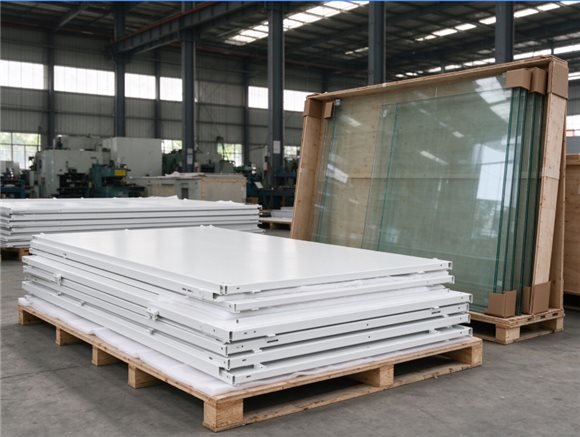
The same cabinet ships two ways: assembled (heavy crate, high freight, higher damage risk) or knock-down (panels flat-packed with foam interlayers, glass crated separately with corner protection). KD packing cuts freight per unit by 30–40% against assembled shipping. On long lanes that difference pays for a glass upgrade — and the packing spec belongs in the quote in writing, not under “as usual.” Freight numbers also move with fuel and lane demand — confirm how long the quoted figure holds.
7. Order volume and terms
Order volume is the biggest lever on unit pricing: a sample, a volume run, and a full container are three different conversations. Exact minimums, volume breaks, and payment terms differ by model — and they move with material markets — so we keep them out of print on purpose. Send your quantity and target specs, and sales will come back with current numbers and terms in writing. Every order goes out with QC photos of the batch before the container seals.
Two costs buyers forget to ask about
Spare glass panels. Glass breaks in transit more often than steel dents, and the signed packing record per crate is what turns that into a fast insurance claim instead of a dispute. Ask whether spare panels can ride with the container — a spare shelf of glass in the load is a rounding error next to a courier-shipped panel after arrival.
Customization lead time. Custom colors and lighting add production days to the standard schedule, and mid-production changes reset the clock entirely. Lock the specification at order confirmation and the lead time holds; change it after the laser starts cutting and it does not.
What to ask before comparing quotes
Four answers separate a real factory from a trading desk: the tempered glass certificate (any serious supplier provides it without hesitation), the coating specification (electrostatic application, stated film thickness), the packing configuration in writing (knock-down, foam interlayers, crated glass), and QC photos of the batch before sealing. If a quote arrives without these, ask — the answers cost nothing and they decide whether the container lands with what you paid for.
How to compare quotes like for like
Send the same specification sheet to three factories: same dimensions, same glass thickness and grade, same lock type, same finish, same packing. When the three quotes come back, the differences you see are real differences in material and process — not three versions of guesswork. That single habit removes most of the risk in sourcing display furniture from China. Keep the spec sheet with the order paperwork — when the goods arrive, it is the reference both sides compare against.
Common questions
Why do quotes for the same cabinet differ so much between suppliers? Hidden specification differences: glass grade, steel thickness, coating process, and packing. Two quotes can describe the same-looking cabinet and be built from different materials. Compare the specification sheet, not the total.
Is a sample order more expensive per unit? Yes — a single unit carries the full production and handling cost. Whether the sample cost can be credited against a later order depends on the model and the deal — ask sales when you request the sample and get the answer in writing. The three things worth testing on it: glass edges, coating finish, and lock action — none of them show properly in photos.
Does knock-down packing really save money? Yes — flat panels use container space efficiently, which is where the 30–40% freight saving comes from. The glass travels in its own crate with corner protection either way, so the saving does not trade off against protection.
What payment terms should I expect? Payment structures differ by order size, model, and market, and they are confirmed in writing with the quotation — sales will walk you through the options that apply to your order.
How do I know a factory quote from a trading company quote? Ask where production happens and request a live video walk-through of the line. A trading desk resells factory output and adds a margin in between; a direct factory quotes from its own production schedule and puts its QC process in writing.
Q: Can the cabinet be built to my shop’s layout instead of a standard size? Yes — dimensions, colors, lighting, and interior layouts are customizable across the line (OEM/ODM). Custom builds price differently from standard models and carry a longer lead time, which is exactly why the quote needs your dimensions rather than a catalog page.
Get a quote
Send quantities and target specs to Ms. Ivy Zhang — ivy.zhang@atoolcabinet.com or WhatsApp +86 135 2691 8367. Luoyang Hengna Office Furniture Co., Ltd., 9 years of industry experience, CE certified production line, direct supply to trade buyers worldwide. For a quote on a full project fit-out, include your floor plan dimensions and we will come back with layout suggestions along with pricing.
Related reading: if material choice is your open question, the sideboard material guide compares steel against wood and MDF for damp environments. For two concrete models with full spec tables, see the SC-1808 commercial showcase and the JY-D500 trophy display case guides.