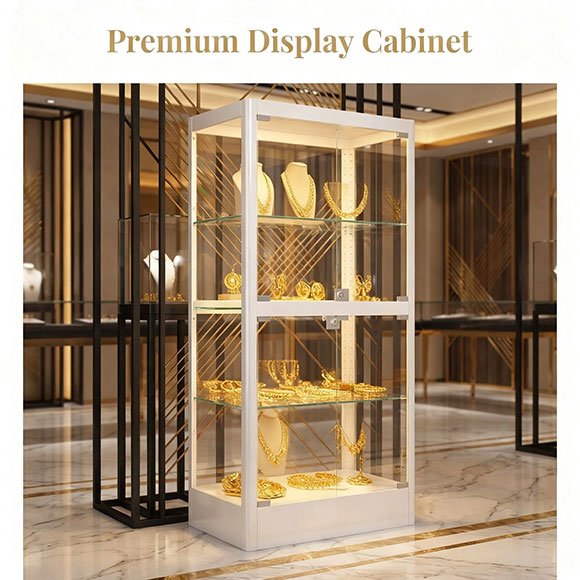
A jewelry store displays the most valuable stock per square foot of almost any retail category — and it displays it at hand height, behind glass that customers expect to see through perfectly. When the specification behind that glass is wrong, the cost arrives twice: once in security, and again in sales that never happen because the pieces could not be seen properly. The display cabinet is where both problems get solved, or both get bought. The six specifications below are the difference between a case that looks right in a showroom photo and a case that works on the floor for a decade.
This checklist covers the six specifications that decide whether a glass display cabinet actually protects jewelry stock — written as the questions to ask before any order is confirmed. It is aimed at jewelry retailers, shopfitters building jewelry sections, and buyers comparing factory quotations. Walk the list with your supplier line by line; a factory that answers all six in writing is a factory that has built for jewelry before. The six below are ordered the way the decisions should be made — security first, presentation second, paperwork last.
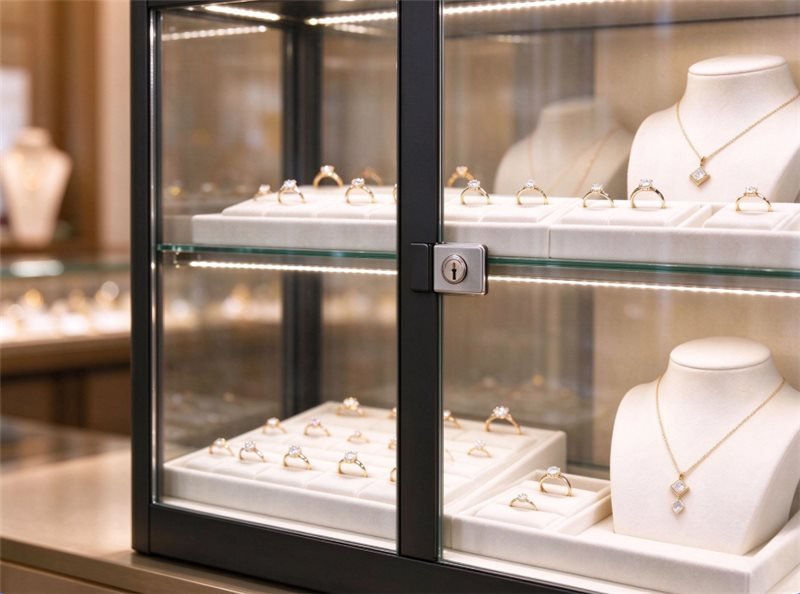
Spec 1: the lock mechanism — ask for it in writing
“With lock” on a quotation can describe anything from a cheap cam lock to a precision mechanism, and in jewelry retail that difference is the product. The specification to ask for is a precision mechanical lock with a dual key system: two different keys are required to open the case, so no single lost or copied key exposes the stock. Staff hold one key, management the other, and the split is what makes the security plan auditable. Ask what the lock is made of, how the key is cut, and whether the mechanism is rated for thousands of cycles — jewelry cases get opened dozens of times a day for years. The audit point matters more than most buyers expect: insurers ask how high-value stock is secured, and a documented dual key system is the answer that satisfies them. Cases with a single shared lock turn every staff member into a key holder — and every key holder into a variable.
Spec 2: glass grade and thickness
Three glass grades cover the jewelry market, and they are not interchangeable. Standard annealed glass breaks into sharp shards — a liability on any public floor. Tempered glass is five times stronger and breaks into blunt granules; it is the commercial default. Laminated glass holds together even when cracked — the step up for flagship stores and high-security installations. Thickness runs 6mm, 8mm, and 10mm: 6mm suits accessories, 8mm is the standard for jewelry counters, 10mm covers flagships. Clarity matters as much as strength — look for 98% transparency or better, because the fire in a stone dies behind tinted or wavy glass. And ask for the tempered glass certificate in the export file: no certificate, no deal. Thickness follows the display style, too: counters with trays sit well behind 8mm, while taller towers carrying stacked stock are the place to price the extra rigidity of 10mm.
Spec 3: lighting — decided before production
Factory-fit LED strips per shelf turn every tier into a lit stage, and jewelry is the category where the display case is expected to glow. The technical detail that matters: wiring channels are cut during production, so the lighting decision belongs at order confirmation. Retrofitting is not realistic — there is no clean way to add channels after the frame is finished. Ask how the strips are powered and whether the finish is exposed or concealed. In jewelry retail the lighting spec is a merchandising decision: lit tiers turn the cabinet into the brightest surface on the floor, and the eye goes there first.
Spec 4: shelving and layout for trays
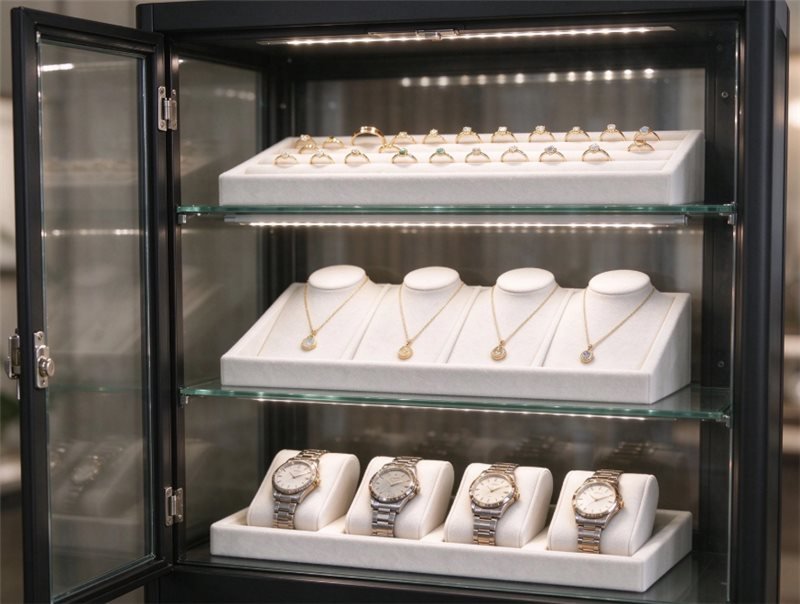
Jewelry is displayed flat, in trays — rings in rows, pendants on pads, watches on cushions. That display style needs tighter shelf spacing than general retail, enough depth for tray lids, and shelving that adjusts as the stock mix changes between engagement seasons and everyday lines. One case can carry a ring wall on the top tier, pendant bars in the middle, and watch cushions below — provided the shelves adjust independently. Ask how the shelves lock into position; pressed tabs slip under years of handling, while notched supports hold. For mixed stock, most stores dedicate tiers by category — rings together, watches together — because customers browse by type, not by cabinet.
Spec 5: finish and footprint
Standard production colors — vintage black, moonlight white, cream white — carry no premium and cover most jewelry interiors: black grounds the lighting, white makes colored stones pop. Custom RAL and Pantone matches run from one container up and align the frames with your joinery and brand palette. Footprint is the spec buyers forget: measure the floor before choosing heights and widths, because narrow profiles exist for small floors and full-depth towers for open showrooms — the wrong footprint is the most expensive mistake to discover at installation. A practical trick from shopfitters: draw the customer flow first, then choose the footprint — the cases should shape the traffic path, not block it.
Spec 6: documentation — the part that outlives delivery
Four documents should travel with the order: the tempered glass certificate, the coating specification, the packing configuration in writing, and QC photos of the batch before the container seals. The glass certificate is the one insurers and inspectors ask about first; the coating spec decides how the frames survive daily cleaning; the packing record turns transit damage into a claim instead of an argument. Keep the set with the order paperwork — it is the reference both sides compare against for years. Digital copies in the cloud and a printed set in the store file cover both sides: inspections on site, claims on the phone.
Common questions
Should all the cases in the store use the same lock system? A uniform lock system is easier to document, easier to train, and easier to underwrite — one key hierarchy covering every case on the floor. Mixed systems are workable but turn the security plan into a map of exceptions.
Q: Can the cabinet be anchored to the floor or wall? Anti-tip anchoring brackets are available at quotation time — recommended for tall towers in earthquake zones and busy malls.
Will jewelry fade behind glass? Tempered glass filters more UV than open shelving or acrylic, which slows fading of display packaging and velvet inserts — but it does not block UV completely. Pieces with sensitive stones should sit away from direct sunlight, and hot-climate stores can ask about UV-filtering glass at specification stage.
Can the finish match an existing store interior? Yes — standard colors ship without a premium, and custom RAL or Pantone matches run from one container up. Jewellers usually align frames with joinery and signage rather than the other way around.
How long does a well-specified case last? Steel frames and tempered glass do not carry the aging problems of MDF and lacquer — no swelling, no off-gassing, no refinishing cycle. A case built to the specifications above is a ten-year fixture with cleaning as the only routine.
Who installs the case? The cases assemble on site with basic tools — panels knock down flat, glass crated separately, hardware bagged with the largest panel. No specialist crews, and the flat-pack form also means the case can move with a refit instead of being rebuilt.
Turn the checklist into a specification sheet
Send your floor dimensions, stock categories, and the six answers above to Ms. Ivy Zhang — ivy.zhang@atoolcabinet.com or WhatsApp +86 135 2691 8367. Luoyang Hengna Office Furniture Co., Ltd., 9 years of industry experience, CE certified production line, direct supply to trade buyers worldwide. We will return a written specification sheet with the quotation — the same six specs, confirmed line by line, so what arrives is what you walked through.
Related reading: for a finished example of a lockable case in a retail setting, the moonlight white showcase guide covers a five-tier collectible-store layout. The commercial showcase wholesale guide covers the full boutique range, and the sideboard material guide goes deeper on the steel-versus-wood question.